my profile

My photo
bandar seri putra, bangi/selangor, Malaysia
Assalamualaikum dan hai...Terima kasih kerana melawat blog ini dibuat khas untuk peminat arnab,berkongsi cerita dan hobi.arnab yang ada disini untuk dipelihara sebagai haiwan kesayangan.kunjungan anda amat dialu-alukan.Nasihat,pandangan dan tunjuk ajar dari semua amat diperlukan..Inilah salah satu Hobi saya pada masa lapang untuk dikongsi bersama kawan-kawan semua h/p no 0126348890. shabibul_qalbie@yahoo.com

Friday, January 20, 2012

Molting

Molting


Molting is when rabbits lose their coat and grow in a new one.  A molt can last from 2-6 weeks or more.  It varies greatly from rabbit to rabbit and from breed to breed.  During this time, they can get a hair ball that can plug them up.  Giving hay daily will help this, but when one gets into trouble, we give them a little bit of dried papaya or fresh banana or even a little fresh pineapple.  In the spring and summer time, a dandelion leaf or two is a special treat for them that they seem to really like.  All of the above seem to help get their system going again.


Wednesday, January 18, 2012

Anggora Rabbit


  1. Although rabbits build nests, they are not chickens and, after initial preparation, will not sit on their nests. They also do not stay on or by the nests after the babies are born. This would attract the attention of predators. The babies burrow to the bottom of the nest where they remain hidden until Mamma Rabbit wakes them up at mealtime.
  2. Only rarely does a mother rabbit nurse her young right after giving birth. Most often the first nursing will occur the night after the kindling. The rabbit's rich milk sustains the babies for 24 hours at a time. The preferred mealtime is between mid night and 5:00 a.m.
  3. A mother rabbit does not lie down in the nest, as a cat would do, but stands over the babies to nurse them. She does, however, clean them and lick their bellies and bottoms to stimulate elimination in much the same way as a cat.
  4. If you want definite proof that the babies are being cared for, check them early each morning. They should be warm and round-bellied. The best way to know for sure is to weigh them on a small postage scale or kitchen scale. Write down a description and the weight. If they're gaining weight (1/4 oz. or so), they're being fed.
  5. You can handle the babies even if the mother doesn't know you. Domestic rabbits are not that concerned over human smells.
  6. Rabbits are not prone to cannibalism, as many people think. Cannibalism is an occasional result of a stillborn litter, and this is nature's way of cleaning up the "mistake." The activity and noisy squeaking of healthy babies trigger the "maternal instincts."Only rarely does a mother rabbit truly abandon or ignore her babies. This may occur when a very Immature rabbit gives birth, In which case, she usually does not build a nest or make any preparations. Her milk production Is also delayed. Sometimes the babies can be hand fed for short time until the mother rabbit can take over the job. Again, their daily weight gain is the test of adequate nourishment.

  7. Generally a male rabbit is tolerant of young rabbits and, if neutered, can remain with his new family. The father will begin to nip and play roughly with the sons as they begin to reach puberty and start acting feisty. Then It's time for separation. A male rabbit must be neutered before being put back with the mother because she can conceive again immediately after giving birth. They should be kept separate for a minimum of two weeks after neutering.

Friday, December 16, 2011

Luna's Babies

Breed Netherland dwarf
Sire B Berry's Merlin
Dam RS's Luna
DOB 14 Dec 2011
total kits 4

Glorious day--your doe has kindled (given birth). The chances of you ever actually watching your rabbits giving birth are very slim. They'll just wait till you leave before giving birth - they can do that, you know.
Me? At this point I’m dying of curiosity.
  • Are all the kits alive and healthy?
  • How many new kits in the nest box?
  • Is the doe taking care of them?
  • Can I safely check, or handle, the kits?

Amazing events, are rabbits giving birth. Let’s answer these questions, because after your rabbit kindles, you need to ensure the doe and the kits are all fine.

Are the baby rabbits all alive and healthy?
You need to know, because if there’s a dead kit in the nest, and there might be, you'll need to remove them before they start rotting, smelling and attracting flies.
There could also be a few stray placentas laying around. The doe usually eats them. This apparently increases the correct hormones that she will need for making milk. But if you find any in the nest, and you might if the litter is large, then just pull them out and throw them away. The doe will have nothing to do with it, once she's finished with giving birth and feeding the babies their first 'meal.'
Rabbit kits are born with their eyes and ears sealed shut, and completely furless. Don’t be alarmed at how they look - it'll take them a couple weeks for the fur to grow in enough to keep them warm outside the nest box.


How many newborn rabbits are there?
Imagine rabbits giving birth to 15 babies! A rabbit litter can number anywhere from 1, all the way to 15. Yes, a couple of our does have kindled 15 kits. No, they didn’t all survive, sadly.
Natural Raw Dog Food
It's just as difficult, rabbits giving birth to just 1 kit. Chances rise that it freezes to death, even in the nest. But one of my does, who had just one kit, sat in her nest and helped keep the little one warm. Smart doe, I thought.
There are ways to help rabbits giving birth to more kits than she can handle. Your outcomes will improve if you remove a few of the babies from the nest, perhaps fostering them to those rabbits giving birth to just a few kits. This gives the stronger kits a better chance at a good start in life, and the weaker ones a better chance at survival.
Here’s how I do it: I let nature take its course for a couple days. At the end of, say, 2 days, it becomes evident which of the kits are not strong. The weaker kits will not be getting their fair share of the doe’s milk, and by, say, 2 days, these kits will have thin abdomens. 

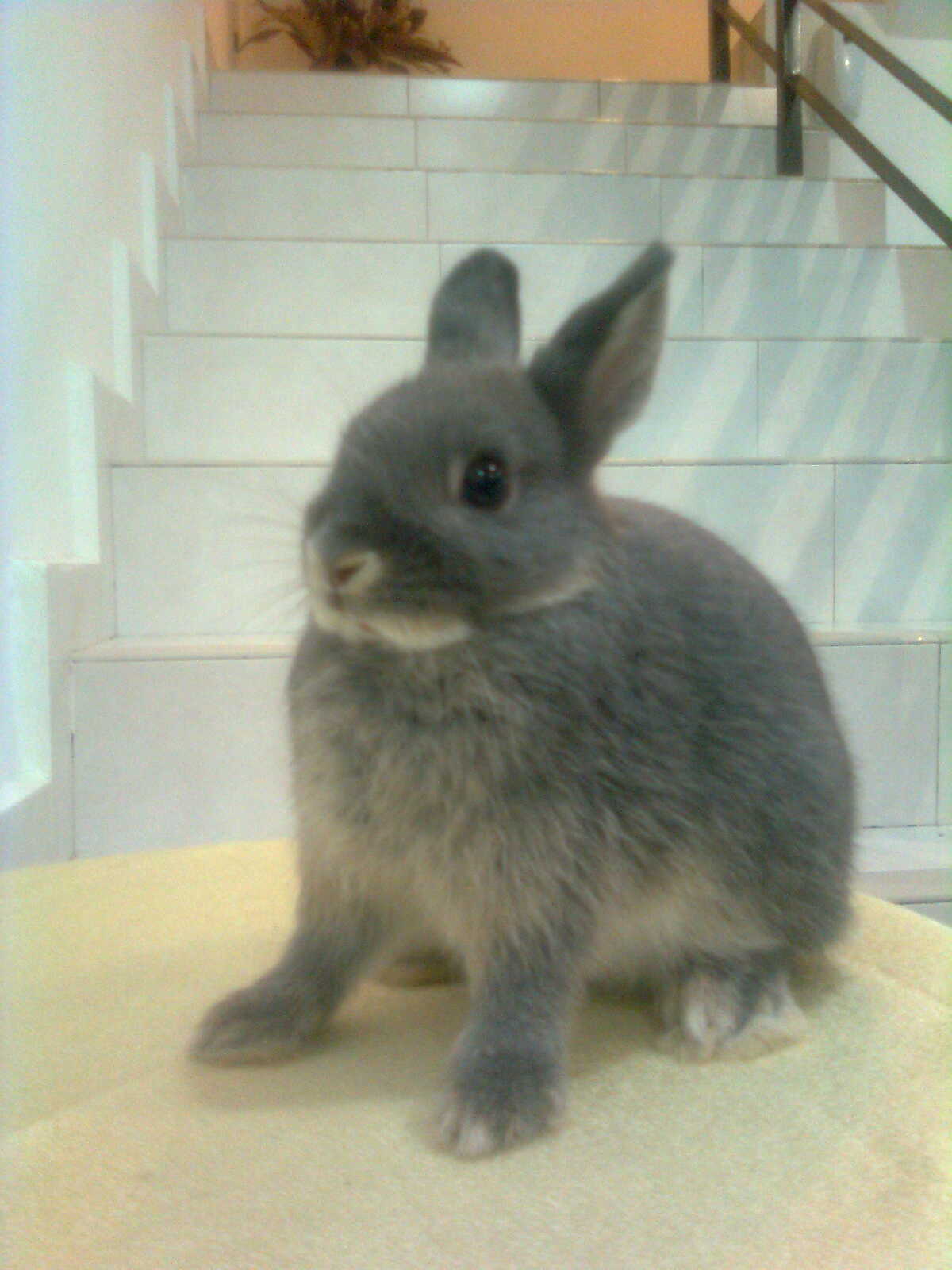
I will remove the scrawny kits from the nest.  the gray bunny has no tummy. You don't want to see such a waist-line! But I'm happy to report that she still managed to get enough milk to do okay. She is still the runt of the litter, but doing very well. She may even turn out to be nice enough to show, once she discovers the delicious rabbit pellets.
Ideally, I reduce the litter size to at most, 10. Sometimes a few more kits become scrawny as well. In this case, the litter might end up numbering around 8. Most does are just fine with 8 kits. That's why I like to have 2 or more rabbits giving birth on the same day. It increases the odds I can foster a few kits to another doe, if necessary.
Is the doe taking care of the baby rabbits?
After rabbits giving birth comes the feeding of the kits, and the doe will likely take excellent care of her babies. But just to be sure, you can check the bellies of the kits. If they have nursed, their little bellies will be round, even distended.

But even if they don’t look full, they might safely go 1 - 2 days before getting a full ‘meal.’ This is probably built into the rabbit as a protective mechanism, since in the wild, the doe might need to stay away from the nest for a while to avoid leading predators to her kits.
Which brings up an important observation for domestic rabbit breeders: Mother rabbits only ever feed their kits once a day, rarely twice, and that for just 5 to 10 minutes. In this short time frame, the kits get their whole day’s milk supply. So, if you never see the doe go near the nest box, but the little kits have round tummies, everything is fine. You don’t need to help nature along. The doe is doing her job while you’re in bed asleep.

Can I safely check on the kits?
What a crazy lot of conflicting information there is on this point!
The answer is: Yes. Here’s how it works:
The doe has spent her 10 minutes in the nest at 11 pm at night. You come along in the morning and check on the kits. Even if you come along in the evening, you can still follow these steps.
  • Give the doe a handful of hay or whole oats (or other favorite treat). This distracts the doe.
  • Remove the nest box from the cage and place on a flat surface.
  • Move the mound of fur aside. If you see any dead baby rabbits or placentas, remove them.
  • Reach down into the deeper recesses of the burrow and pull out all the kits, counting each one.

    • Place them on top of the shavings in front of the burrow, one by one, where you can see them.
    • Observe that there are no dead kits in the back, down in their little sleeping burrow, and if there is, remove them.
    • Check that each kit has a full tummy and seems healthy. If the litter is large, there may be one or two whose bellies are not as full as the others, however hopefully they will have had at least some milk, and you can make a note to recheck in a day.
    • Replace the kits where you found them. Some may have already crawled back down into their burrow. Mound the fur where you found it, over top of the burrow.
  • Put the nest box back into the cage.
    The doe will come check it out. She might hop in the nest and feed her babies, but chances are better that she won’t return to her babies until late at night.
  • In the meantime, the kits will pick up the scent of their nest again, and lose your scent.
  • If your doe knows you and your scent, and is comfortable with you, the chance is very great that she’ll be completely unimpressed by your scent on the nest box. I have NEVER had a doe reject her litter because I checked the nest box.

  • If you have doubts, for example, if you acquired a pregnant doe who is unfamiliar to your home, if you never handle the doe, or if you know your doe is skittish or highstrung, then put a dab of vanilla extract on her nose. She won’t be able to smell anything else for a while, they tell me. You can check the kits safely, and they will lose your scent by the time she goes back into the nest to feed them.

Friday, December 9, 2011

dwarf rabbit information


If you’re a breeder of dwarf bunnies, or simply interested in knowing more about tiny rabbits, you’ll want to understand how the DWARF gene works, and how to manage your breeding program in order to maximize the numbers of true dwarf rabbits.
Let’s see how dominance versus recessive rabbit genetics principles apply to the DWARF gene.

The principles of dominant and recessive inheritance are the same for the dwarf gene as for other genes you just read about, such as rabbit coat color genetics.
The dwarf gene works as a simple dominant gene. This means that just one dwarfing gene will produce a dwarf rabbit. If you’re thinking ahead of me, you’ll already be formulating the following questions in your mind:
  • Since rabbits always receive TWO genes for every trait, what happens if a rabbit receives TWO dwarf genes?
  • What if a dwarf ends up with two normal-size genes? Is it still a dwarf?
Every rabbit has two size genes, along with the many gene duplicates for fur color, eye color, etc. Each sire and dam will pass on one of their size genes to each offspring, which will re-combine to make two per offspring.
Since the dwarf gene is dominant, just one dwarf gene will produce a dwarf rabbit. But this dwarf gene is also deadly, if paired with a second dwarf gene. Without a normal gene as a recessive back-up, a rabbit who inherits two copies of the dwarf gene always dies.
Here are the combinations of SIZE genes that any rabbit could receive:
  • Dwarf and Dwarf, or...
  • Dwarf and Normal, or...
  • Normal and Normal
What do these combinations "look" like in real rabbits?
The double dose of the dwarf gene results in a "peanut." A two-dwarf-gene combination is always fatal. The reasons for this are unclear, but it is thought that the double dwarfs have digestive and brain insufficiencies. They usually last 1-3 days past birth, but a few have lasted up to 3 weeks.
Peanuts are excessively tiny.
If you’re breeding any of the dwarf breeds, now you know why those tiny kits in your nestbox died. Breeders of the dwarf breeds deal with peanuts as a regular part of breeding.
The rabbits that get one normal gene and one dwarf gene are known as TRUE DWARFs. These are the animals that you want in your litters. True dwarfs are animals that match the standard of perfection for their dwarf breeds.
If the true dwarf is a Netherland Dwarf rabbit, it is round, short, and compact. The ears are short, and the feet are correct.
The true dwarf Holland Lop is tiny but massive, with all the correct proportions. And the other breeds carrying the dwarf gene are correct for their standards.
The rabbit that gets two normal genes is known as a FALSE DWARF.He does not carry a dwarf gene at all. But for most dwarfed breeds it’s not like you’ll get a twelve-pound rabbit.
Because the Netherland Dwarf rabbit is little to start with, the false dwarf is just a little bigger than normal. His ears will be a tad longer than normal, his body will be longer and gangly, and the feet will be longer. In fact, the Netherland Dwarf rabbit and Holland Lop breeders have a term for their false-dwarfs - "big uglies."
Most BUB's - big ugly bucks - are sold as pets. These false dwarfs are still very cute of course. But, if the BUB is very promising in many ways other than size, the option is open to keep the buck as part of your breeding program, for use with a true dwarf doe.
Similarly, dwarf breeders frequently consider keeping the BUD - big ugly doe - as a brood doe, if her body type is promising (not counting the extra size). Because remember, ideal dwarf rabbits have ONE dwarf gene and ONE normal gene. The BUD will contribute that normal gene to 100% of her offspring.
Given that dwarfs need both a normal and a dwarf gene, how can you expect dwarf rabbit genetic percentages to work out in the nestbox?
Remember that gene match-ups are totally random, luck-of-the-draw, a coin-toss. In one litter, there’s no telling what combinations you might get of true dwarfs, false dwarfs and lethal peanuts in one litter. But over many litters, the odds even out.
If you breed together two true dwarfs you’ll end up with:
  • 25 percent peanuts. These will all die, of course.
  • 50 percent true dwarfs. These are your keepers.
  • 25 percent false dwarfs. The BUD (doe) you might consider keeping as a brood doe. The bucks most likely you’ll sell as pets.
If you breed a true dwarf buck to a ‘big ugly doe’ (false dwarf), you’ll end up with:
  • 50 percent true dwarfs (your keepers)
  • 50 percent false dwarfs
So whether you use does that are true dwarfs or false dwarfs, if bred to a true dwarf buck, you’ll end up with 50% true dwarfs.
There could be a few advantages to using a BUD as a dam:
  • The larger doe may kindle more kits in a litter, increasing the odds for true dwarfs in a small measure.
  • The larger doe may produce more milk.
  • Lastly, because the BUD has only normal size genes to contribute, you won’t find any peanuts in the nest box. (Peanuts have to get a dwarf gene from each parent.)
On the other hand, you'll need a true dwarf doe in order to test whether your buck is a true dwarf or a false one (it's not always so easy to tell). Any peanuts in the litter PROVES the existence of a dwarf gene in both sire and dam, because both contributed a dwarf gene to the peanut.

There's nothing wrong with using an outstanding true dwarf doe for breeding purposes. Just be prepared to find a peanut or two in your litters. Some dwarf breeders cull the peanuts when they find them, and some wait until they expire on their own. If you choose to wait, do check the nest every day so you can remove them once they die. This keeps the nest clean from decay, odor and flies.
These breeds carry a DWARF gene:
  • American Fuzzy Lop
  • Dwarf Hotot
  • Holland Lop
  • Jersey Wooly
  • Lionhead Rabbit
  • Mini Rex
  • Mini Satin
  • Netherland Dwarf
I didn’t list the Polish rabbit or the Britannia Petite above, because technically, these miniature breeds are not ‘dwarfed.’
True Britannia Petites have been selectively bred for their tiny size - 2 1/2 pounds as an adult. (Max 3 1/2 pounds for Polish rabbits.) However, according to the American Britannia Petite Rabbit Society, most Britannia Petite bloodlines in the USA have been ‘corrupted’ with genes from Netherland Dwarfs in order to obtain a desired color gene. Along with the varied colors, the dwarf gene came along for the ride. Breeders of some "brit" bloodlines now find peanuts in their litters.
The same may also be true of some Polish rabbit lines.
All is not lost, however. Breeders can still test-breed, discover those individual rabbits that carry the dwarf gene, and eliminate them from their breeding program.

Wednesday, November 23, 2011

Desa Vista's EG


Feeding your Netherland Dwarf Rabbit. When feeding a Netherland Dwarf rabbits, it is important to remember that they do not need a high level of sugar or protein or a large bowl full of food. When feeding a mixed food the rabbit must eat everything that you give it. If you over feed the rabbit it will only pick out it's favourite bits and leave everything else and will not get a complete diet. Fibre is of the utmost importance to keep your rabbit fit, healthy and using their teeth correctly.
ADULT RABBITS:The basic diet for a healthy adult rabbit should consist of unlimited access to freeze dried grass or/and a good Quality Meadow hay, along with a variety of fresh vegetables (these need to be introduced slowly) and a limited amount of rabbit food---every day about 1.5oz's . Obesity is common in pet rabbits, and excessive amounts of food should be avoided. The first, soft stools that a rabbit passes are eaten again (a process called coprophagia). This is thought to supply the rabbit with most of its Vitamin B requirement,it also containsabout  healthy bacteria that the rabbit needs to digest their food. Thus helping to prevent diarrhoea.
BABY RABBITS:Rabbit food about 2-2.5oz's, freeze dried grass or/and hay should be available in unlimited quantities to baby rabbits starting at about three weeks of age. 

Hay/ freeze dried grass:is crucial to your rabbit's health as it is the main source of fiber/roughage which aids the digestion, helps prevent g.i. stasis and hairballs and it is helpful in keeping your rabbit's teeth in good shape. Grass hays or freeze dried should be available in unlimited quantities to all rabbits.
Rabbit food, should always be fresh. Don't buy more than three month's supply at a time or they may get stale and lose nutritional value.
Rabbits rely on a stable population of "good" bacteria in their gut, any changes in dietary intake should be introduced gradually to avoid sudden changes in types of bacteria present, as this can result in diarrhoea. Diarrhoea can kill.
My Rabbits are feed on my own mix of Rabbit food, along with Millen Munchy Grass and a Lovely Green Meadow Hay. These can be viewed at Dee Millen Rabbit Accessories.
Millen Rabbit Food:A complementary food for rabbits, to be fed in conjunction with forage such as clean hay or freeze dried grass, fresh water must be available at all times. Oil 4%, Protein 13%, Fibre 10%, Ash 5.6%. VitA 1000iu/kg, Vit D3 1400iu/kg, Vit E 40iu/kg, copper 20mg/kg.
Millen munchy grass:is a freeze dried grass, made from pure grass with only the water taken out. Protein 15%, Fibre 32%, Oil 2%, Prosphours 4g/kg. Very good for making a rabbit use it's back teeth corectly. This is a natural product which may vary in appearance throughout the season, this does not affect the nutritional value
Meadow hay:Last years cut,lovely and green, smells great the bunnies love it,
Water:Clean water must be accessible to rabbits at all times.  A sipper water bottle is the best choice because it cannot be contaminated with bedding, food, feces and urine. Rabbits unfamiliar with a sipper bottle may have to be trained to use it. It is not necessary to add vitamins to the water if the recommended diets are followed. The disadvantages of adding vitamins to the water include; making the water taste disagreeable and promoting bacterial growth. Bio plus can be added to the water when you first bring your pet home, this will help him settle in. Medications can be added to the water  but only under the advice of your vet. If you are not sure whether your bunny is drinking, place a small bowl by the rabbits water bottle. If a rabbit stops drinking, within a couple of days, it will stop eating. So always check that the bottle is working, by flicking the end.
Freezing Water Bottles: I use a product called Vyderphor this is a four in one disinfectant, not only does it help to stop the water from freezing, it also stop the bottles from going green in the summer. It keeps the water fresh and clean. it can also if used stronger be used for cage and aerial disinfecting as well as scrubbing out food dishes and litter trays, i find it very good for getting rid of buck wee from up the walls of cages.
An idea is to have two bottles on the go, one on the cage with a bottle cover on, the other indoors, when you go out to check
bunnies you swap the bottles over, the rabbits will drink almost straight away because the water will be at room temperature,
which they enjoy, and they will soon learn that when it is cold, mummy or daddy will swap bottles.
 
Dental Care
We all need to take care of our teeth, but that is especially true in the case of pet rabbits. The most common complaint is overgrown molars and enamel spurs that grow from teeth. These spurs generally develop because rabbits aren't eating enough forage and hay. These naturally-abrasive, fibre-rich foods are important because they wear down the teeth Rabbits' teeth grow continuously by an astonishing 2mm every week, or 10-12cm every year, a lack of fibre in the diet means that problems can quickly develop. Left untreated, uneven or insufficiently worn molars can lead to secondary complaints. Even if dental disease has already been diagnosed, the Excel Feeding Plan or correct feeding, can aid the chances of recovery and stop problems deteriorating further.

Monday, November 14, 2011

ND kits available /for sale


available buck and doe
RM250 -rm300 Negotible
pm for the best price
Dob 8/10/2011
boleh ambil pada awal disember 2011
US Bloodlines with pedigree
Chocolate carry

Tuesday, November 1, 2011

Midnight's Eclipse (Midnight Rabbitry - ZR Rabbitry - Reko Rabbitry - RS Rabbitry)


CH. Midnight’s Tahoe 
Grand Champion Sr. Buck
G.C. Midnight’s Aldo (REW) x Midnight’s Saratoga (Siamese Sable)


CH. Midnight’s Papaya
Grand Champion Sr. Doe
Bramhall's Mark  (Sia. Sable) x Midnight’s Pear (Sable Marten)
BOSV @ 2007 ARBA Convention
Pictured in the ANDRC Guidebook


MIDNIGHT'S ECLIPSE